Unit 5: Confronting the Darkness
How do we confront the darkness within us?
Do all humans have a dark side that we must work against in order to be “good”? What can we learn from exploring this other part of us? What happens when we allow this darker nature to drive us? We also have a natural desire to seek out and explore the mysterious and sometimes it is even enjoyable to scare ourselves, but when does it go too far? Why do you think people enjoy being frightened?
Over the course of this unit, we will explore both real and literary perspectives about the darker side of human nature, mystery, and fear. We will track the development of this theme, as well as the figurative language that enhances it, in poetry, short stories, nonfiction articles, film, and a culminating creative project.
Questions to get you thinking:
What is EVIL?
What is the appeal of fear and horror?
Do we all have a dark side?
What are the elements of an effective horror story?
Targeted skills:
Understand theme and analyze an author’s purpose
Identify mood and tone and how they are established in a story
Recognize figurative language in poems, short stories, and essays
Analyze multimedia representations of similar topics
List of possible texts:
Nonfiction:
Short Stories:
“Dr. Heidegger’s Experiment” by Nathaniel Hawthorne (CommonLit)
“Young Goodman Brown” by Nathaniel Hawthorne or “Young Goodman Brown”(CommonLit)
“Fall of the House of Usher” by Edgar Allen Poe (CommonLit)
“Masque of the Red Death” by Edgar Allen Poe (CommonLit)
Illustrations Inspired by Poe
“A Rose for Emily” by William Faulkner or A Rose for Emily (Commonlit)
“A Good Man is Hard to Find” by Flannery O'Connor or A Good Man is Hard to Find (CommonLit)
Art:
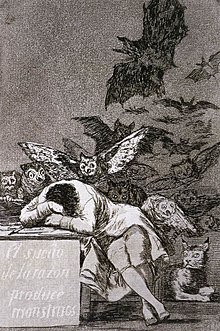
The Sleep of Reason Produces Monsters by Francisco Goya (1799)
Self Portrait and Death Playing a Fiddle by Arnold Böcklin (1872)
Poetry:
“The Raven” by Edgar Allen Poe (CommonLit)
"We Grow Accustomed to the Dark" by Emily Dickinson (CommonLit)
Film
The Man with the Black Suit
Nightmares & Dreamscapes: You Know They Got a Hell of a Band
Summative Rubric:
Rubric for creative adaptations:
|
Advanced (4) |
Proficient (3) |
Basic (2) |
Below Basic (1) |
|
|
Accuracy of Representation
_____/20 |
Representation includes key characteristics, the mood/tone is well represented, and the viewer get a clear sense of the original theme from the project. |
Representation includes key characteristics, the mood/tone is represented. Viewer gets a general sense of the theme from the project. |
Representation includes some key characteristics, the mood/tone is represented. Difficult to get a sense of the original theme from the project. |
Key characteristics, mood/tone, and/or theme is difficult to discern or irrelevant. |
|
Aesthetics
_____/20 |
Project is appealing, and elegant; complexity is refined and skillfully presented; project creates enthusiasm (unease, fear, dread, horror, surprise, disgust, desire) and communication. |
Project has appealing aspects and is clearly presented; project is adequate. |
Project has some appealing aspects and elegance which may not be fully developed; project is not consistently inspiring. |
Project needs development, revision and/or organization; project is incomplete or lacking technical competence inhibiting engagement. |
|
Use of Medium
______/10 |
Media selection enhances the reimagining of the inspiration piece. Media is used in an appropriate manner. |
Media selection is suitable to the reimagining of the inspiration piece. |
Media selection is suitable, but has too many elements that resembles the original. |
Reason behind the media selection is unclear. |
Rubric for inspiration piece analysis & artist statement:
|
Advanced (4) |
Proficient (3) |
Basic (2) |
Below Basic (1) |
|
|
Inspiration Piece Analysis
_____ /20 |
Provides a detailed analysis of how specific tone, mood, and themes (found in quotes, word choice, lighting, brushstrokes, shading, etc.) produce gothic elements. |
Analyzes tone, mood, and theme adequately. Relevant yet general gothic elements are found. |
Attempts to analyze tone, mood, or theme in general terms. |
Elements stated don’t match the work chosen or analysis of gothic elements is lacking. |
|
Metaphorical Interpretation (in artist statement)
_____/20 |
Provides a detailed explanation of how specific tone, mood, and themes found in inspiration piece are interwoven and reinvigorated in student-created piece. |
Adequately explains how tone, mood, and theme found in inspiration piece are represented in student-created piece. |
Attempts to explain how tone, mood, or theme found in inspiration piece can be identified in student-created piece. |
Tone, mood, or theme found in inspiration piece are not identified in student-created piece. |
|
Writing
_____/10 |
Writing is clear, concise, and fluid. Both works are eloquently described and organization works to enhance overall quality. |
Writing is organized and easily understandable but may not be concise or fluid. Both works are described. |
Writing shows an attempt at following an organizational pattern. |
Writing is difficult to understand due to lack of clarity and organization.Works are not done justice. |
Logging in, please wait... 
0 General Document comments
0 Sentence and Paragraph comments
0 Image and Video comments
Comments are due January 01, 2022 00:00
New Conversation
General Document Comments 0