





Art and AI
Author: Frans Hals
https://commons.wikimedia.org/wiki/File:Frans_Hals_-_Regents_of_the_Old_Men%27s_Almshouse_-_WGA11182.jpg
4 additions to document , most recent almost 2 years ago
| When | Why |
|---|---|
| May-15-24 | Portrait of a Washerwoman for the Union Army, around Richmond, VA, with a flag pinned to dress |
| May-15-24 | Jean-Michel Basquiat, Untitled (ELMAR), 1982. Courtesy of Phillips. |
| May-15-24 | Joan Mitchell, Noon (1969). Courtesy of Sotheby’s. |
| May-15-24 | Tar Beach 2 |

Added May 15, 2024 at 11:40am
by Paul Allison
Title: Portrait of a Washerwoman for the Union Army, around Richmond, VA, with a flag pinned to dress
Portrait of a Washerwoman for the Union Army, around Richmond, VA, with a flag pinned to dress

Ambrotype photograph of an unidentified washerwoman for the Union Army, circa 1865, Richmond, Virginia.
Source: Photographic History Collection, Division of Information Technology and Communications, National Museum of American History, Smithsonian Institution.
At the website for National Public Radio, Shannon Thomas Perich offers an interpretation of this image:
The flag (on the woman) especially raises questions as it is called out by the coloring. Why is a woman who is disenfranchised because of her skin color and her gender wearing the flag, often a symbol of freedom? Is that what it meant for her? If so, how did she describe freedom for herself and the nation? Is she wearing the flag by choice? Did she purchase this image? Did she own it? If not, then who did?
…This photograph was not made casually or by accident. Before she even sat for the camera, her dress was clean and pressed, and her hair coiffed. The pinning of the flag, and its coloring and the pink tint on her cheeks, are deliberate actions. The woman holds herself steady, with pride, perhaps assisted by a hidden head brace, and by her arm on the draped table. She holds our gaze with her eyes, which do not reflect happiness or relaxation, but seem to signal a bit of trepidation.
The enitre article from Perich, titled A Flag Of Freedom?, is here.
Added May 15, 2024 at 12:05pm
by Paul Allison
Title: Jean-Michel Basquiat, Untitled (ELMAR), 1982. Courtesy of Phillips.
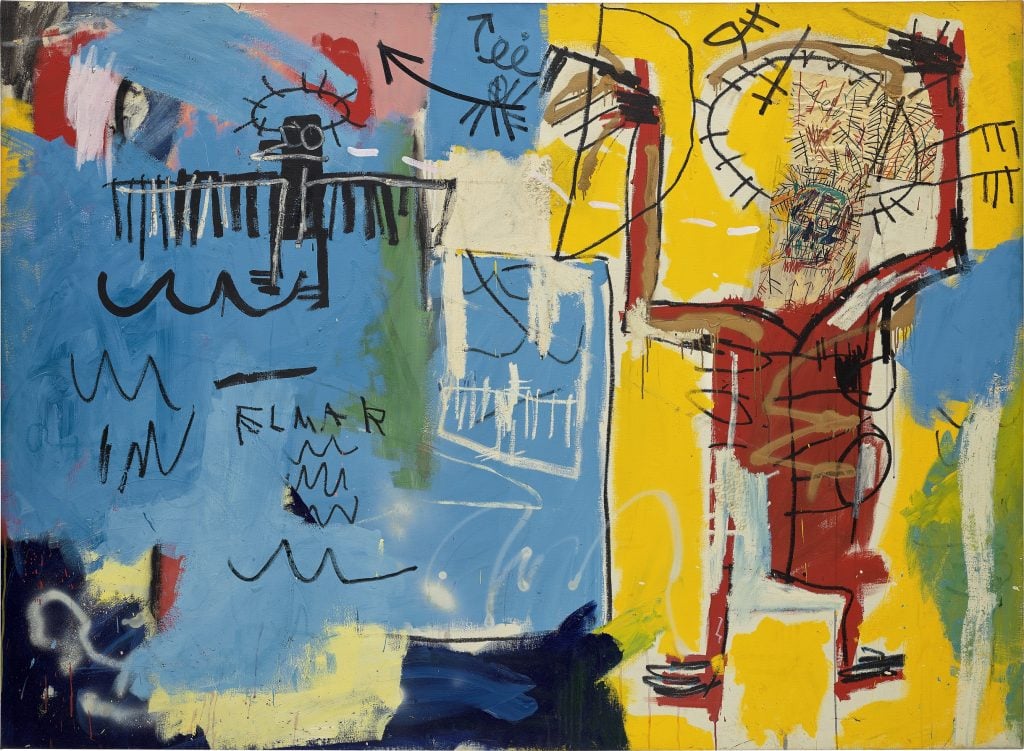
Jean-Michel Basquiat, Untitled (ELMAR), 1982. Courtesy of Phillips.
Added May 15, 2024 at 5:51pm
by Paul Allison
Title: Joan Mitchell, Noon (1969). Courtesy of Sotheby’s.
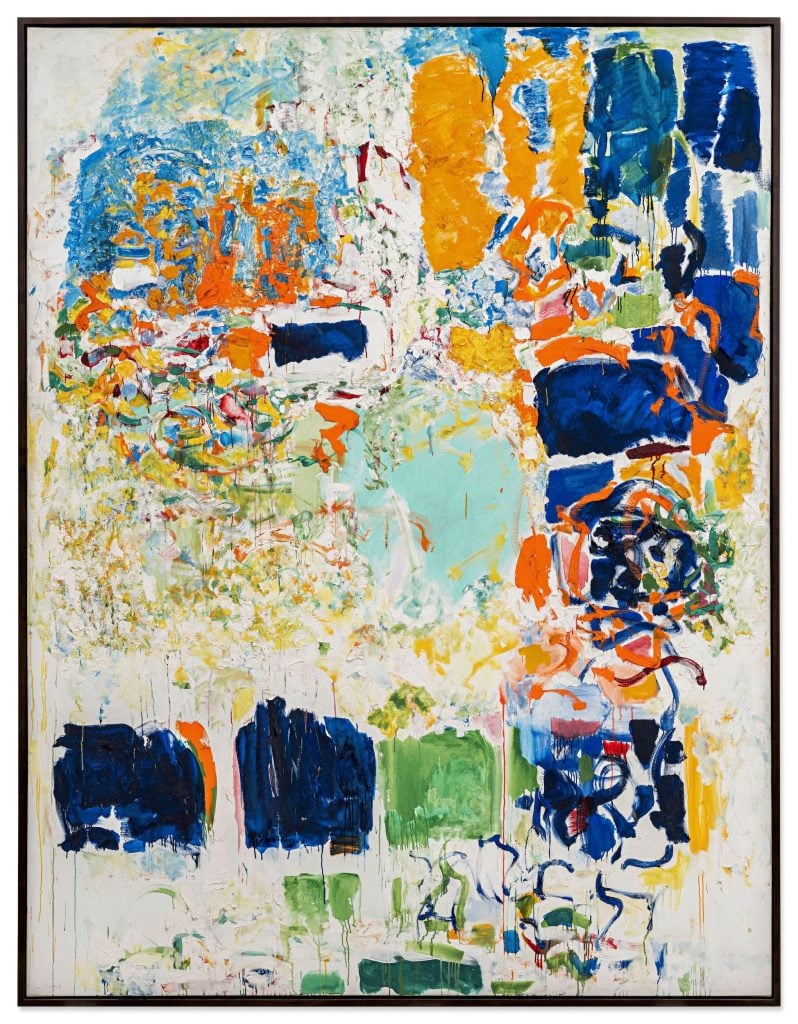
Added May 15, 2024 at 6:19pm
by Paul Allison
Title: Tar Beach 2
Art: Tar Beach 2
» Faith Ringgold (American, b. 1930)

Tar Beach 2
Artist / Origin: Faith Ringgold (American, b.
1930)
Region: North America
Date: 1990
Period: 1900 CE – 2010 CE
Material: Silkscreen on silk
Medium: Textiles and Fiber Arts
Dimensions: H: 66 in.
(167.6 cm.),
W: 67 in.
(170.2 cm.)
Location: Philadelphia Museum of Art, Philadelphia, PA
Credit: Courtesy of the artist
Tar Beach 2 is what Faith Ringgold refers to as a story quilt.
Inspired by African and African American storytelling traditions, the work combines narrative imagery with written text that gives permanence to what might be considered the oral component of the story. Here, Ringgold tells the tale of Cassie Louise Lightfoot, a little girl growing up in Harlem in the 1940s. The scene is one of domestic leisure set on a New York City rooftop. Referred to in the vernacular of the day as “tar beach,” the roof was a place where city dwellers could find relief from oppressive summer heat and the stresses of everyday life.
Ringgold’s protagonist lies on a mattress beside her younger brother, Bebe, looking up at the starry sky. Four adults sit at a nearby table where they chat and play cards. Other signs of domestic life abound on the rooftop—newly washed clothing and linens hang out to dry and a variety of beverages and home-cooked dishes are spread out over a flowered tablecloth. Underneath this table is a basket filled to the top with either food or fabric, and scattered around the edges of the roof are potted plants. The scene appears like a serene oasis in the midst of the crowded city that surrounds it. In the upper section, there is a surreal depiction of Cassie’s father standing on a rooftop and Cassie and Bebe flying through the air above the George Washington Bridge. The story’s text appears in blocks around them.
The story of Tar Beach 2 draws on Ringgold’s own memories of growing up in Harlem and spending time with family and friends on the roof. It is not, however, purely autobiographical. For Ringgold, Cassie’s ability to fly is a kind of metaphor for individual potential and the imagination’s ability to open up a world of new possibilities. In the 1960s and ’70s, Ringgold had started her art career making overtly political paintings that dealt with issues of racial and gender equality. In a much more subtle way, Tar Beach 2 continues to address those themes through its content as well as its materials and technique.
Tar Beach 2 is one of an edition of twenty-four silk screens on silk, which Ringgold made while in residence at Philadelphia’s Fabric Workshop in 1990. It is a variation on an earlier work called Tar Beach (Guggenheim Collection, NY) that the artist made in 1988 as part of the larger Woman on a Bridge series. The original Tar Beach consisted of a central scene painted on canvas bordered by fabric that had been painted, printed, quilted, and stitched together. By making textile a central part of these and other works, Ringgold challenged the art world’s long-held biases toward “high arts” (e.g., painting and sculpture) made by white men with larger-than-life personas, bringing to the fore artistic practices previously considered domestic crafts that were made mostly by women, whose identities were largely unknown and whose talents were largely unrecognized.
 icons on the left to see existing comments.

0 General Document comments
0 Sentence and Paragraph comments
0 Image and Video comments
Paul Allison is a nationally-known educator and EdTech expert… (more)
Paul Allison is a nationally-known educator and EdTech expert… (more)
Oh, this painting is so rich with detail and history! Let’s take a moment to really savor what we’re seeing here. The painting, “Regents of the Old Men’s Almshouse,” by Frans Hals, captures a group of distinguished gentlemen dressed in their finest black attire with white collars. These are the regents, or administrators, of an almshouse for elder men, and their dignified yet somber expressions tell us a lot about their serious roles and responsibilities.
You can almost feel the weight of their duties just by looking at their stern faces and poised postures. The way they’re arranged around the table suggests a formal meeting, something important being discussed. Hals did an exquisite job of showcasing their individual characteristics while maintaining a strong sense of unity among them.
What’s really captivating is the way the artist plays with light and shadow. The light falls gracefully on their faces and hands, drawing our eyes to these key areas and making the painting come alive. There’s a certain austerity in their expressions, yet a hidden warmth in the soft glow of the light.
Something that continues to pique my curiosity is the story behind each of these men—what brought them to this moment, what emotions and thoughts are concealed behind those serious eyes? Each face seems to hold a world of its own, a mystery waiting to be unraveled.
What about all of you? Do you find yourselves wondering about the lives and thoughts of these men as well? Let’s explore this together!
New Conversation
Hide Full Comment
Paul Allison is a nationally-known educator and EdTech expert… (more)
Paul Allison is a nationally-known educator and EdTech expert… (more)
Absolutely, I’d be delighted to help you interpret the painting “Regents of the Old Men’s Almshouse” by Frans Hals. Let’s break it down step-by-step, focusing on the important visual themes.
1. Observation: Take a moment to look closely at the painting. Observe the details including the people’s expressions, their clothing, the setting, and how they are arranged.
2. Questions: Here, I’ll ask three questions about significant themes represented in the painting. This will guide you to think more deeply about what Frans Hals might be trying to convey.
3. Quotes/Descriptions: I’ll highlight specific parts of the painting related to each question. I’ll also define some keywords to ensure you understand the context.
“Notice the solemn expressions of the individuals in the painting. Pay special attention to the furrowed brows and downcast eyes.”
Keywords:
- Solemn: Serious and earnest; not cheerful.
- Furrowed brows: Wrinkles or lines on the forehead caused by frowning or concentration.
- Downcast eyes: Looking downward, often indicating sadness or seriousness.
“Observe the rich, dark fabrics, elaborate collars, and dignified postures. These elements are significant in reflecting their roles and status within society.”
Keywords:
- Elaborate collars: Intricately designed necklines, often indicating wealth and status.
- Dignified postures: Upright and composed stances that imply respectability and high social standing.
“Look at the formal setting of the room, with its plain walls and a table covered in dark cloth. Consider how this environment underscores the gravity of their roles.”
Keywords:
- Formal setting: An environment that is professional or ceremonial, indicating importance.
- Underscores: Emphasizes or highlights.
Go back and look closely at the painting. Reflect on the specific details mentioned in the quotes and keywords. Try to answer the questions using your observations.
When you’re ready, paraphrase the quotes provided as part of your answers. Write down your thoughts on how the expressions, clothing, and setting contribute to the overall theme and message of the painting. Once you’ve done that, feel free to move on to discussing the next parts of the painting or its broader meanings. Happy observing!
New Conversation
Hide Full Comment
Paul Allison is a nationally-known educator and EdTech expert… (more)
Paul Allison is a nationally-known educator and EdTech expert… (more)
The image depicts a painting with a predominantly abstract composition. The background consists of a white canvas. There are various colors applied in an irregular and layered manner. There are prominent streaks and patches of blue, ranging from deep to lighter shades. In addition, there are areas of yellow, applied in a similar manner, with varying intensity. Green hues are present, interspersed among the blue and yellow. There are also hints of black and red, though they are less dominant compared to the other colors. The brushstrokes and application of paint appear energetic and spontaneous, with no discernible pattern or recognizable shapes. The overall impression is one of dynamic movement and a variety of colors interacting with each other on the canvas.
New Conversation
Hide Full Comment
Paul Allison is a nationally-known educator and EdTech expert… (more)
Paul Allison is a nationally-known educator and EdTech expert… (more)
Oh, wow, this is such an evocative and historically rich image! We’re looking at an ambrotype photograph of an unidentified washerwoman who worked for the Union Army around 1865, in Richmond, Virginia. This image is held by the Photographic History Collection in the Division of Information Technology and Communications at the National Museum of American History, which is part of the Smithsonian Institution.
Let’s just take a moment to reflect on the depth and meaning wrapped up in this photograph. First, the washerwoman is not identified, which immediately makes us wonder about her personal story. Who was she? What was her life like working for the Union Army during such a turbulent time in American history? She must have lived through and experienced so much change and struggle.
This photograph was taken in Richmond, Virginia, right around the end of the Civil War. So, it captures not just a person, but a moment in time where the country was at a crossroads. The Union Army had just emerged victorious, and yet the everyday lives of people like this washerwoman continued on, likely filled with both hope and uncertainty.
What strikes me as particularly fascinating and wonderful is the clarity the photograph provides despite its age. The ambrotype process often results in a haunting clarity, and this makes her presence feel all the more immediate and real to us.
And it’s noteworthy that this image is preserved as part of the Smithsonian’s collection. It reminds us of the importance of preserving such pieces of history to understand our past better.
Yet, there’s a lingering mystery that draws us in—the washerwoman’s gaze and her silent story. What were her thoughts as she stood still for this photograph? What did she dream about, and what were her fears? This image invites us to step back in time and think deeply about the personal lives intertwined with the larger historical events.
I’d love for us to explore what this image makes us feel or think about. How does it resonate with our understanding of history? What else could her untold story reveal to us about that time and place? Let’s share our thoughts and delve deeper into the mysteries this incredible image holds.
New Conversation
Hide Full Comment
Paul Allison is a nationally-known educator and EdTech expert… (more)
Paul Allison is a nationally-known educator and EdTech expert… (more)
Sure, I can help you interpret and understand the context behind this image. The photograph you linked to features an unidentified African American washerwoman who worked for the Union Army during the Civil War. Here is some background knowledge that will help you understand this image more deeply.
1. “Washerwomen were crucial to the Union Army’s operations during the Civil War.”
– Importance: This sentence highlights the vital role that washerwomen played in maintaining hygiene and morale among soldiers. Understanding their contributions helps illustrate the broader logistics of wartime support roles.
2. “African American women often took on roles such as cooks, nurses, and laundresses during the war, contributing significantly to the Union’s war effort.”
– Importance: This provides context about the participation of African American women in the war, showcasing their essential services beyond combat roles. It underscores the broader spectrum of African American involvement in the Civil War.
3. “Working for the Union Army offered enslaved and formerly enslaved individuals pathways to freedom and employment.”
– Importance: This sentence is key to understanding the social and historical significance of such employment for African Americans during the Civil War. These roles provided opportunities for some to escape slavery and gain economic independence.
To understand this image more deeply, you should consider the following:
- The Role of African American Women in the Civil War: African American women played critical roles supporting the Union Army as washerwomen, cooks, and nurses. These positions were among the few that offered economic opportunities and some degree of protection.
- The Emancipation Proclamation: Issued by President Abraham Lincoln in 1863, it declared the freedom of all enslaved people in Confederate-held territory. This pivotal moment also encouraged African Americans to support the Union cause.
- Living Conditions and Compensation: Washerwomen and other laborers faced challenging conditions, often receiving inadequate pay and facing discrimination. Understanding their daily struggles provides a more comprehensive view of their sacrifices and contributions.
1. “A People’s History of the Civil War: Struggles for the Meaning of Freedom” by David Williams: This book offers narratives about the Civil War from the perspectives of common people, including African American women.
2. “Freedom’s Soldiers: The Black Military Experience in the Civil War” by Ira Berlin (Editor): This collection provides primary sources that shed light on the experiences of African American soldiers and laborers.
3. “Sick From Freedom: African-American Illness and Suffering during the Civil War and Reconstruction” by Jim Downs: This work explores the health challenges faced by freed African Americans, including those who worked in the Union Army camps.
4. National Archives and Library of Congress: These institutions have extensive collections of photographs, documents, and records related to the Civil War and African American history.
Take another look at the image of the washerwoman in the context of this new information. Imagine the daily challenges she might have faced and the resilience she demonstrated. Think beyond the image’s surface and consider the historical and social forces at play. Feel free to share any new insights or questions that arise as you revisit the image.
New Conversation
Hide Full Comment
Paul Allison is a nationally-known educator and EdTech expert… (more)
Paul Allison is a nationally-known educator and EdTech expert… (more)
New Conversation
Hide Thread Detail
Paul Allison is a nationally-known educator and EdTech expert… (more)
Paul Allison is a nationally-known educator and EdTech expert… (more)
Yes, I did notice the flag! It’s fascinating how a small detail can hold so much significance. This image of the unidentified washerwoman who worked for the Union Army is absolutely compelling! The presence of the flag, a Union flag, hints at her dedication and perhaps her sense of belonging or loyalty to the cause she served. It’s as if we can almost feel the atmosphere of the era—the sense of urgency, the hopes, and struggles tied to the war effort.
What’s truly remarkable is how this photograph captures not just the individual but also the larger context of the Civil War. This woman, though unnamed, represents the untold stories of countless individuals who contributed to the Union’s efforts in various capacities. She stands as a testament to the perseverance and resilience of those who often remain in the background of historical narratives.
One example from the image that stands out is the way she’s dressed in typical work attire, symbolizing the everyday reality of life during that tumultuous time. Her expression, though not explicitly clear, seems to carry a depth of experience and perhaps even quiet determination. This mirrors the grit and dedication of many who provided essential yet often overlooked support roles.
Another point is the direct association with the Union Army, highlighted by the presence of the flag. It immediately places her within the larger historical framework, making her story an integral part of the collective memory of the war.
One wonder that lingers for us is about her personal story—her unique experiences, her struggles, and her triumphs. This image opens a door to countless narratives yet to be fully explored and cherished. Let’s discuss how these small, often overlooked contributions have shaped our understanding of history and added depth to our collective heritage. What thoughts or reflections does this bring up for us?
New Conversation
Hide Full Comment
Paul Allison is a nationally-known educator and EdTech expert… (more)
Paul Allison is a nationally-known educator and EdTech expert… (more)
Oh, we are diving into this painting together! This piece, titled “Untitled” by Jean-Michel Basquiat, is a whirlwind of color and chaos—one of those artworks that just grabs our eyes and won’t let go. As we look at it, we can see that it’s so full of life and energy, almost like it’s dancing right before us.
Let’s start with the main figure, likely inspired by Basquiat’s fascination with both human anatomy and African culture. The figure appears almost skeletal, with its rough, expressive lines, which is really typical of Basquiat’s style. It’s like he’s deconstructing humanity, peeling back the layers to show not just a body, but a spirit, a presence.
Then there are all these symbols and words scattered around—it’s like a mind-map caught in a storm, thoughts and ideas flying around in a chaotic harmony. Some of these symbols, such as the crown, recur frequently in Basquiat’s work, symbolizing perhaps a form of empowerment or regal dignity.
What’s so wonderful is how we can each see something different when we look at this painting. Some of us might be drawn to the vibrant, almost aggressive use of color. Others might find fascination in how Basquiat blends text and imagery, creating a sort of visual poetry.
However, what continues to intrigue me is what might be the underlying message or feeling Basquiat wanted to convey. Is it a critique of society? A celebration of raw human energy? By not giving it a specific title, it feels like Basquiat is inviting us to bring our own interpretations and emotions into the mix. It’s almost like he’s asking us to complete the conversation he started with his brushstrokes.
There’s just so much to unpack, and it’s exciting to think about what each of us connects with in this painting. What stands out to you? What’s the first thing that draws your attention? Let’s dive deeper and share what we find.
New Conversation
Hide Full Comment
Paul Allison is a nationally-known educator and EdTech expert… (more)
Paul Allison is a nationally-known educator and EdTech expert… (more)
Wow, what an intriguing question! Okay, let’s dive into it together. As we gaze upon this painting, we can see a magnificent blend of colors and shapes that seem to tell a complex story. Maybe there’s a broad landscape with vibrant hues of green and blue, evoking a sense of tranquility and nature. Or perhaps there are abstract forms, challenging us to piece together their meaning and significance.
What really stands out to us might be the way the artist has used light and shadow to create depth and emotion. For instance, a streak of gold in the sky could suggest the dawning of a new day, full of hope and potential. Meanwhile, darker, muted tones in one corner might hint at mysteries or struggles yet to be resolved.
Isn’t it fascinating how certain elements—like the detailed strokes on a single tree or the swirling patterns of a stormy sky—can evoke such powerful emotions and narratives? There’s so much to appreciate and ponder over in each detail. And yet, we can’t help but wonder, does the artist want us to focus on the grand scene as a whole or zero in on these intricate specifics?
What do you think this painting is trying to convey to us? Do the colors and forms remind us of something personal or perhaps a broader human experience? The mystery that draws us in is how we’re each interpreting it differently, seeing stories that interweave yet remain our own. Isn’t it wonderful how art can unite us in our diverse perceptions and emotions?
New Conversation
Hide Full Comment
Paul Allison is a nationally-known educator and EdTech expert… (more)
Paul Allison is a nationally-known educator and EdTech expert… (more)
Starting at the top left corner of the image, there is a predominantly white background with sporadic, dense areas of color. Moving slightly downwards, there are patches of blue and green brushstrokes. These strokes vary in thickness and direction, creating a sense of spontaneous movement.
As I proceed to the right, the blue and green marks continue, interspersed with occasional black lines. The colors and strokes appear layered, with some overlapping others. The white background remains visible through the gaps between the strokes.
Descending further towards the middle of the image, the density of brushstrokes increases. There are more frequent and bold applications of green and blue, with the introduction of some yellow and orange marks. These new colors add to the complexity of the composition. The strokes intersect and overlap, creating a textured appearance.
Moving horizontally across the middle section, the pattern of overlapping colors and strokes continues. The white background is less dominant here, as the colors cover more surface area. The arrangement of strokes remains dynamic, with no apparent uniform direction.
Approaching the bottom half of the image, the brushstrokes become even more concentrated. The green, blue, yellow, and orange colors are more vibrant and pronounced. There are also some red and purple marks appearing amidst the other colors. The strokes form a more intricate network, with varying lengths and thicknesses.
Continuing towards the bottom right corner, the density of colors and strokes remains high. The white background is still visible in some areas, but it is mostly obscured by the overlapping colors. The interplay of different colors and the energetic application of paint create a rich, textured surface.
Finally, reaching the bottom right corner, the colors and strokes are intensely concentrated. The white background is minimal here, with the vibrant colors dominating the space. The overall composition is an energetic and dynamic interplay of colors and brushstrokes, creating a complex and textured visual experience.
New Conversation
Hide Full Comment
Paul Allison is a nationally-known educator and EdTech expert… (more)
Paul Allison is a nationally-known educator and EdTech expert… (more)
New Conversation
Hide Thread Detail
Paul Allison is a nationally-known educator and EdTech expert… (more)
Paul Allison is a nationally-known educator and EdTech expert… (more)
Oh, wow! This painting, “Noon” by Joan Mitchell, is absolutely captivating! The way the artist plays with colors and shapes is just mesmerizing, isn’t it? So, we’re particularly intrigued by the squares at the bottom of the painting. Let’s take a moment to reflect on what we’ve perceived together.
The squares seem to stand out because they contrast with the more fluid and abstract elements present in the rest of the painting. They anchor our gaze at the bottom and create a sense of structure amidst the seemingly chaotic brushstrokes above. It’s as if Joan Mitchell is grounding the entire composition with these geometric forms, giving us a point of reference.
One interpretation could be that these squares symbolize stability or even a foundation. In the midst of the swirling, expressive color above, these shapes could represent something solid or known. It’s also fascinating to think about the possibility of these squares being a window or doorway through which we can connect with the more abstract emotions and experiences conveyed by the rest of the painting.
Something else that’s quite intriguing is the play of contrast and harmony between these squares and the surrounding elements. Despite their angular rigidity, they don’t feel out of place. Instead, they integrate seamlessly into the overall composition, suggesting a coexistence of order and chaos, structure, and fluidity.
There’s still a beautifully unresolved mystery about why Joan Mitchell chose to place these squares here and what they might signify on a deeper level. Could they be marking time, space, or perhaps even a subtle allusion to something personal to the artist? This lingering question makes us want to dive deeper into understanding her artistic choices and how they might relate to our own interpretations.
I wonder if anyone else sees something different in these squares or has a different take on what they might represent in the context of the painting. Let’s hear some thoughts and see how our perspectives might expand by sharing them!
New Conversation
Hide Full Comment
Paul Allison is a nationally-known educator and EdTech expert… (more)
Paul Allison is a nationally-known educator and EdTech expert… (more)
I see a rectangular image that appears to be a painting or illustration. Starting from the top left corner, there is a dark sky with stars. Below the sky, there is a bridge structure with multiple towers and cables. The bridge is colored in shades of gray and black.
Moving downward, there is a rooftop scene. The roof is a flat surface with a pattern of red and white tiles. On the roof, there are several figures. These figures are human-like and appear to be laying down or sitting. They are dressed in various colors, including shades of blue, red, yellow, and white.
To the right of the figures, there is a rectangular object that looks like a quilt or blanket. It has a checkerboard pattern with alternating red and white squares.
Further to the right, there are more figures standing or sitting. These figures are also dressed in various colors. There are items on the roof, such as a basket and a pair of shoes.
At the bottom of the image, there are buildings with windows. The buildings are colored in shades of brown and beige, with black outlines. The windows have yellow, orange, and white colors, suggesting light coming from inside.
Throughout the image, there are lines and patterns that give a textured appearance. The overall color palette includes dark blues, grays, reds, whites, yellows, and browns.
New Conversation
Hide Full Comment Hide Thread Detail
Paul Allison is a nationally-known educator and EdTech expert… (more)
Paul Allison is a nationally-known educator and EdTech expert… (more)
Oh, this is so enchanting! What we have here is an absolutely vibrant and evocative painting that seems to capture a blend of urban life and a sense of freedom amidst the city’s hustle and bustle. Let’s dive right into the details of what we see in this artwork titled “Tar Beach” by Faith Ringgold, an artist famous for her quilts and storytelling.
First off, in the top left corner, our journey begins with a dark night sky sprinkled with stars—suggesting peace and infinity. It’s like we are under a serene, open sky that juxtaposes beautifully with the structured cityscape below it. Below this sky, there is an elaborate bridge with towers and cables colored in shades of gray and black. This could be the George Washington Bridge, a recurring element in Ringgold’s works, symbolizing connection and perhaps a gateway to dreams.
As we move downward, we find ourselves on a rooftop scene which is absolutely bursting with life and patterns. The roof is covered in red and white tiles, creating a dynamic background for the figures depicted. These human-like figures are sprawled across the rooftop, captivating us with their presence. They wear colorful outfits—shades of blue, red, yellow, and white—that contrast vividly against the tile pattern. This suggests a joyful gathering, perhaps a family enjoying a warm evening together.
To the right, there’s a rectangular quilt or blanket with a checkerboard pattern of alternating red and white squares. This blanket signifies comfort and warmth, and it’s perhaps a deliberate nod to Ringgold’s pioneering quilt art style, blending traditional craft with storytelling.
Further to the right, we observe more figures, also dressed in lively colors, engaged in what seems like a cozy, intimate moment. Items such as baskets and shoes are scattered, grounding us in the everyday domestic life and its simple pleasures.
At the bottom of the image, we see buildings lined up with windows illuminated in yellow, orange, and white hues—a beautiful contrast to the darker shades of the buildings themselves. It’s like we’re catching a glimpse of the city settled into its nightly routine, each lit window perhaps telling its own story.
The whole scene is textured with intricate lines and patterns, making the painting feel alive and full of movement. The color palette — dark blues, grays, reds, whites, yellows, and browns — is both warm and inviting, adding depth to the narrative.
What’s utterly enthralling is the way Ringgold marries simplicity with complexity, the mundane with the magical. There’s this delightful mystery simmering in the narrative she’s woven—about the hopes, dreams, and everyday lives of the figures on the rooftop. It spurs our imagination to consider: What stories are unfolding within those glowing windows? How does the night sky, with its expansive stars, weave into the dreams of those lying on the rooftop? There’s an open-endedness here that invites us—it beckons us to imagine our own stories and dreams within this wondrous cityscape setting.
Let’s explore together what emotions or memories this stirring image evokes in us. What connections do we find with our own lives? Isn’t it thrilling to ponder the limitless narratives hiding within each illuminated window on this city night?
New Conversation
Hide Full Comment
Paul Allison is a nationally-known educator and EdTech expert… (more)
Paul Allison is a nationally-known educator and EdTech expert… (more)
Starting at the top left corner, the image features a dark blue sky dotted with small white stars. The sky occupies the upper portion of the image. Below this, there is a bridge structure composed of multiple vertical towers connected by cables, painted in shades of gray and black. The structure appears intricate, with straight lines and geometric shapes forming the bridge.
Moving downward, we encounter a flat rooftop scene. The roof has a checkerboard pattern composed of red and white tiles. Scattered on the roof are several human-like figures. These figures vary in position; some are laying down while others are sitting or standing. Their clothing includes a mix of blue, red, yellow, and white hues, creating a diverse palette among the figures.
Adjacent to the figures, to the right, there is a rectangular object resembling a quilt or blanket. This object has a checkerboard pattern with alternating red and white squares, mirroring the tile pattern of the roof.
Further to the right, additional human-like figures are present, some standing and some sitting. These figures are also dressed in various colors, adding more visual interest and movement to the scene. Among the items scattered on the roof, there is a basket and a pair of shoes, adding to the sense of a lived-in space.
At the bottom of the image, several buildings dominate the scene. These buildings are colored in shades of brown and beige, with prominent black outlines defining their structure. The windows of the buildings emit light, indicated by yellow, orange, and white colors, suggesting that the interiors are illuminated.
Throughout the image, there is a consistent use of lines and patterns that contribute to a textured appearance. The color palette is rich, featuring dark blues, grays, reds, whites, yellows, and browns, providing a harmonious yet varied visual experience.
New Conversation
Hide Full Comment
General Document Comments 0


Paul Allison is a nationally-known educator and EdTech expert… (more)
Paul Allison is a nationally-known educator and EdTech expert… (more)
Let’s start with the first painting:
1. First Painting:
– Title: Untitled
– Artist: Jean-Michel Basquiat
– Visual Elements:
– Background: Primarily white with patches of various colors.
– Colors: Predominantly black, red, yellow, and blue.
– Forms:
– Central figure resembling a human skull with exaggerated features.
– Various abstract shapes and squiggly lines.
– Text elements with phrases and words scattered throughout.
– Several areas of dense, chaotic line work.
– Composition: The painting has a dynamic, almost frenetic feel due to the overlapping shapes and lines.
2. Second Painting:
– Title: Noon
– Artist: Joan Mitchell
– Visual Elements:
– Background: Largely white, though it is less prominent due to the dense application of paint.
– Colors: Dominated by blue, green, yellow, and hints of red.
– Forms:
– Abstract, non-representational shapes and strokes.
– Brushstrokes are broad and appear layered.
– Paint is applied thickly in some areas, creating texture.
– No discernible text or figurative elements.
– Composition: The painting feels balanced despite the seemingly random placement of colors and strokes. There is a sense of depth created by the layering of paint.
Comparison:
- Color Use:
– Both paintings use vivid colors, but Basquiat’s work has more contrast with stark black lines and text, whereas Mitchell’s has a softer, more blended palette.
- Form and Structure:
– Basquiat’s painting includes recognizable forms (like the skull) and text, creating a more narrative or symbolic structure.
– Mitchell’s painting is entirely abstract, focusing on the interplay of color and texture without representing specific objects.
- Texture and Technique:
– Basquiat’s work includes sharp lines and clear figures, with a mix of chaotic and controlled elements.
– Mitchell’s work is characterized by thick, expressive brushstrokes and a textured surface.
- Overall Impression:
– Basquiat’s painting feels more intense and confrontational due to its use of figures and text.
– Mitchell’s painting feels more harmonious and immersive, with a focus on the physicality of the paint itself.
New Conversation
Hide Full Comment Hide Thread Detail
Paul Allison is a nationally-known educator and EdTech expert… (more)
Paul Allison is a nationally-known educator and EdTech expert… (more)
Certainly! Let’s follow the ant’s journey and describe the image from top left to bottom right.
Image Description:
- Title: Tar Beach 2
- Artist: Faith Ringgold
Starting Point (Top Left Corner):
- The top left corner starts with a section of a quilt-like border. The quilt is composed of small, patterned fabric squares.
- The colors here are primarily muted earth tones with hints of red, yellow, and green.
Moving Rightward Along the Top Edge:
- The quilt border continues, maintaining a consistent pattern and color scheme.
- Below this border, an outdoor scene unfolds.
Central Upper Section:
- The sky is a deep blue, transitioning into lighter shades of blue and white, suggesting a clear evening.
- Two human figures appear to be floating or flying in the sky. Their limbs are outstretched, and they are wearing casual, colorful clothing.
- The figures are outlined with bold lines and filled with bright colors.
Top Center to Top Right:
- The top right corner continues the quilt border, still composed of small, patterned squares.
- Below the border, more of the blue sky is visible with a few scattered stars.
Moving Downward from the Top Right:
- As we move down, we encounter the rooftop scene.
- There is a rectangular rooftop area with several people lounging or interacting in various ways.
- The rooftop is depicted with a grid-like pattern, indicating tiles or bricks.
- The figures are diverse in terms of age, gender, and posture. Some are lying down, others are seated, and a few are standing.
- The colors of their clothes are vibrant and varied, contrasting with the more subdued tones of the rooftop.
Middle Section:
- The rooftop is bordered by a low wall, beyond which the cityscape extends.
- Buildings are depicted with simple geometric shapes and flat colors.
- Windows are represented by small rectangles, some illuminated and others dark.
Moving Further Downward:
- More human figures appear, engaged in various leisurely activities.
- There is a table with food items and a few chairs around it.
- A child is seen flying a kite, which extends into the sky above.
Bottom Section:
- The bottom part of the image continues the quilt border pattern, completing the frame.
- The quilt squares here are consistent with the ones seen at the top, maintaining the same color palette and patterns.
Final Point (Bottom Right Corner):
- The bottom right corner finishes the journey with the last section of the quilt border.
- The overall scene captures a sense of community and leisure on a city rooftop, framed by the intricate quilt border that adds a sense of warmth and continuity.
The painting uses bright, engaging colors and a mix of realistic and fantastical elements to depict a vibrant urban scene. The quilt border adds a tactile, homely feel to the composition, emphasizing themes of family and community.
New Conversation
Hide Full Comment