





Native American Mascots: Pride or Prejudice
Native American mascots: Pride or prejudice?
By Moni Basu, CNN
(CNN) – Suzan Shown Harjo remembers when she walked into a store with her grandfather in El Reno, Oklahoma. She wanted to get something cool to drink on a summer day. It was the early 1950s and the storekeepers told the 6-year-old she had to leave.
“No black redskins in here,” they said.
At that moment, Harjo felt small, unsafe, afraid. Because she was a dark-skinned Native American – Cheyenne and Hodulgee Muscogee – she was being identified by just her coloring. She wasn’t even a whole human being. Not even her grandpa, whom she saw as all-powerful, could do anything to protect her.
Later in her life, that incident made her angry. Angry enough for Harjo to launch a lifelong mission to protect her people.
Part of her work took aim at sporting teams that use Native Americans as mascots. With the start of the baseball season this week, some of those teams have been front and center. The Cleveland Indians, for instance, feature a smiling Indian dubbed Chief Wahoo, criticized by Native Americans as a racist caricature.
The most offensive example of a mascot, says Harjo, is the one used by Washington’s football team. She has been fighting for years to get the Redskins to change their name.
The R-word – she can’t even bring herself to say it – is the same as the N-word, says Harjo, president of Morning Star Institute, a national Native American rights organization.
She finds it unbelievable that more than half a century after she was told to get out of that El Reno store, after decades of civil rights struggles and progress on race relations, Americans have no problem with rooting for a team called the Redskins.
Fans say the name is an honorific. But the Merriam-Webster dictionary says this: “The word redskin is very offensive and should be avoided.” And to many Native Americans, nothing could be more derogatory than the use of that word.
“The Washington team – it’s the king of the mountain,” Harjo says. “When this one goes, others will.”
The controversy over Native American names in sports is longstanding and surfaces in headlines now and then, as it did in December when the Atlanta Braves baseball team was reportedly considering bringing back a dated “screaming Indian” logo for batting practice caps.
Or when Amanda Blackhorse, a 31-year-old Navajo social worker, went to Washington last month to attend a hearing of the Trademark Trial and Appeal Board. She has petitioned to cancel the Redskins trademark on grounds that the name is racist. Harjo filed a similar petition in 1992 and won, but she later lost in the appeals process.
Harjo was defeated in the courts, but public opinion has been shifting steadily on the matter.
In March, several lawmakers introduced a bill in Congress that would amend the Trademark Act of 1946 to ban the term “redskin” in a mark because it is disparaging of native people. Among the sponsors of the bill is civil rights activist Rep. John Lewis, D-Georgia.
Harjo says she hopes the legislation will accomplish what litigation has failed to do so far.
If passed, the bill would force the Washington football team to discard its trademarked name and ban the use of any offensive term in any future trademarks.
Proponents believe that Native American mascots pay homage to the people and help promote a better understanding of those who dominated America before Europeans landed.
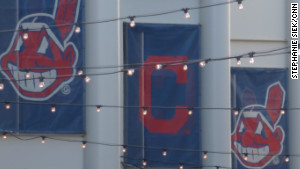
The Cleveland Indians mascot, Chief Wahoo, has been criticized as a racist caricature.
But opponents say the mascots perpetuate stereotypes that are void of context and history. They argue that even if the mascots themselves are not racially insensitive, they portray native people as one-dimensional.
“A good many Americans don’t know any Indians,” says Kevin Gover, who heads the Smithsonian Institution’s National Museum of the American Indian.
“The Indian you see most often in Washington, D.C., is at a football game – at the expense of real Indians, real history, real culture. The petty stereotype has become expected.”
In February, the Smithsonian museum hosted a symposium on racist stereotypes and cultural appropriation in American sports. The idea was to make people think about how these stereotypes can be damaging to Indians.
“Kids grow up and think it’s OK,” Gover says. “It’s not OK.”
There used to be more than 3,000 teams with Native American names and mascots. That’s down to about 900 now – but that’s still 900 too many for Gover.
He grew up, also in Oklahoma, and recalled how the University of Oklahoma became the first collegiate team to drop its unofficial mascot, Little Red, a student who dressed as an Indian chief and danced on the sidelines during football games.
Protests on campus forced the demise of Little Red. In 2005, Oklahoma adopted two costumed horses, Boomer and Sooner, as mascots who represented the real horses that pulled the Sooner Schooner. But many students didn’t take to them.
One of them was Royce Young, who wrote about the university’s “mascot crisis” in an online forum in 2007:
“But why can’t OU bring back Little Red? Oklahoma prides itself on being ‘Native America.’ American Indian heritage is something that is more prevalent in this state than any other in the nation. Would it be so wrong to have Native American imagery representing ‘Native America?’ "
Young, 27, and a writer for CBS Sports, said he now believes he would have written a more educated post after having discussed the mascot issue with Native Americans.
"I wouldn’t say I regret writing it,” he said. “But I’d be much more sensitive of understanding why Little Red was insensitive to some instead of saying, ‘What’s the big deal?’ ”
Royce said he saw nothing wrong with Oklahoma honoring its native people, but not with a tasteless mascot.
Several college teams followed Oklahoma’s footsteps and dropped Native American mascots – Stanford and Syracuse among them.
The movement to do away with Indian mascots gained momentum after theAmerican Psychological Association in 2005 called for the immediate retirement of the mascots based on studies that showed the harmful effects of inaccurate racial portrayals.
The following year, the NCAA, the governing body of collegiate sports, adopted a policy banning teams with “hostile or abusive racial/ethnic/national origin mascots, nicknames or imagery” from competition. The ban affected high-powered football schools such as Florida State University with Chief Osceola and the University of Illinois, whose official symbol was Chief Illiniwek.
Some states have put the morality of the Indian mascots up for a vote.
Last year, voters dumped the University of North Dakota's Fighting Sioux mascot.And Oregon prohibited public schools from the use of Native American names, symbols or images. The names on the banned list include: Redskins, Savages, Indians, Indianettes, Chiefs and Braves.
At Florida State University, a white man dresses up as Chief Osceola, smears war paint on his face and rides an appaloosa called Renegade to the middle of Doak Campbell Stadium. He plants a burning spear on the field before every home game. The marching band plays Indian-themed music, and the crowd goes wild doing the “tomahawk chop,” a move picked up by the Atlanta Braves.
FSU student Lincoln Golike, who played Osceola in 2002, told the Florida State Times back then that it was tremendous honor to have so many admiring fans.
The Seminole tribe in Florida made an agreement with FSU to allow the use of its name that allows the university to continue competing in the NCAA. The university says its relationship with the Seminole tribe is one of mutual respect.
However, the Seminole nation in Oklahoma, comprised of the descendants of a majority of the Seminoles forced from their lands by the Indian Removal Act, has voiced its opposition to FSU’s mascot.
The real Chief Osceola fought U.S. soldiers in the Seminole Wars. He was captured in 1837 under a flag of truce and died in prison. Before his burial, the soldiers chopped off the head of the Indian warrior to keep as a trophy. That Osceola serves as a mascot at FSU doesn’t sit well with the Seminoles in Oklahoma and many other Native Americans.
“Native Americans feel offended, they feel hurt. They feel their identity is being trivialized,” says Carol Spindel, who wrote “Dancing at Halftime,” a book that explored native mascots.
“This is such an ingrained part of American culture that it’s very hard to get people to question it,” says Spindel, a professor at the University of Illinois at Urbana-Champaign, where the official symbol used to be Chief Illiniwek. He was the subject of debate for decades and made his last appearance in 2007 under the threat of NCAA sanctions.
But five years later, there are still some who want Illiniwek back. A nonbinding student referendum held just weeks ago strongly favored making him the official mascot again.
Spindel concluded in her book that mascots such as Chief Illiniwek were a reflection not of native people but of those who invented them.
“If we do a census of the population in our collective imagination, imaginary Indians are one of the largest demographic groups,” Spindel writes in her book.
“They dance, they drum, they go on the warpath; they are always young men who wear trailing feather bonnets. Symbolic servants, they serve as mascots and metaphors. We rely on these images to anchor us to the land and verify our account of our own past. But as these Indians exist only in our own imaginations, they provide a solipsistic connection and leave us, ultimately, untethered and rootless.”
At 67, Harjo believes she has made strides in her struggle to do away with racial stereotypes but says Native Americans have a long way to go.
“Because we as Indians, we don’t have the numbers,” she says, referring to the dwindling population. The latest census listed 2.9 million people as American Indian and Alaska Native.
“So we don’t pose a threat,” she says. “If we organized a march, the numbers would be so small. We’ve done it school by school. State by state.”
Harjo knows if the powerful Washington football team is forced to discard its name, then everyone else will follow. But for now, she takes pride in small victories.
Just a few weeks ago, a high school in Cooperstown, New York, decided to retire its R-word mascot.
C.J. Hebert, superintendent for the Cooperstown Central School District, said students approached him regarding their discomfort with the mascot that had been around for decades.
“I do think that times change and perspectives change, and certainly it’s historically a time for us to reconsider what the name is,” Hebert said.
That’s a statement that makes Harjo feel her campaign has been worthwhile.
Tell us what you think about Native American names and mascots below.
 icons on the left to see existing comments.
0 General Document comments
0 Sentence and Paragraph comments
0 Image and Video comments
New Conversation
Hide Thread Detail
New Conversation
This paragraph is showing pathos because it is including that the store walker had said that awful thing to a “6 year old”. Obviously when you include how young the child is you’re going to show sympathy for them.
New Conversation
Hide Full Comment Hide Thread Detail
New Conversation
This is an example of pathos because she uses her experience as a little girl to make the reader feel sympathy for her. It helps even more since this is at the beginning of the article before any claims are made.
New Conversation
Hide Full Comment
The author is using pathos in this paragraph by provoking anger in the reader against racism. This sentence is basically the forefront of the authors argument.
New Conversation
Hide Full Comment Hide Thread Detail
New Conversation
New Conversation
I agree
New Conversation
Hide Full Comment
New Conversation
Hide Full Comment Hide Thread Detail
New Conversation
This is an example of a polysyndenton. It shows that serious the matter of the situation was.
New Conversation
Hide Full Comment Hide Thread Detail
Polysyndeton means: "Repetition of conjunctions in close succession, especially when most of them could be replaced with a comma.
New Conversation
Hide Full Comment
I politely disagree because there isn’t any FANBOYS
New Conversation
Hide Full Comment
The author used pathos to make us feel bad for the poor 6 year old who felt worthless at the time.
New Conversation
Hide Full Comment
This makes the reader feel bad for the reader because she was discriminated against when she was so young
New Conversation
Hide Full Comment
In the first sentence there is ayndeton because there is no conjunctions.
New Conversation
Hide Full Comment
This is an example of a polysendenton because there is no conjunctions in the sentence where it could have added the conjunction “and”.
New Conversation
Hide Full Comment
This real life account shows the struggle Native American people have to experience. This shows logos because the author is using quotations,and opinions from experts.
New Conversation
Hide Full Comment
New Conversation
Hide Thread Detail
the author is using Ethos to show her passion for protecting people and their beliefs
New Conversation
Hide Full Comment
This logos because it is a recent topic and also many other people have shared their opinion about the mascot
New Conversation
Hide Full Comment Hide Thread Detail
New Conversation
New Conversation
New Conversation
New Conversation
Hide Thread Detail
I agree
New Conversation
Hide Full Comment
Moni uses pathos because many people can relate to the feeling of being called something degrading, like the N word, thus making people understand what she is going through.
New Conversation
Hide Full Comment Hide Thread Detail
I agree but i also feel that this could also be an example of parallelism because it shows the similarity in both words
New Conversation
Hide Full Comment
I agree with your comment.
New Conversation
Hide Full Comment
I agree
New Conversation
Hide Full Comment
New Conversation
Hide Thread Detail
I agree with this.
New Conversation
Hide Full Comment
This is an example of ethos because the speaker is Native American which makes her an authority on what is offensive to Native Americans because she is one.
New Conversation
Hide Full Comment Hide Thread Detail
New Conversation
This paragraph shows parallelism because it is putting the R word and the N word close together to show the reader how awful they both are.
New Conversation
Hide Full Comment Hide Thread Detail
I agree.
New Conversation
Hide Full Comment
New Conversation
New Conversation
She is making you mad and telling you how R word is like saying the N word to native Americans
New Conversation
Hide Full Comment
This is an appeal to the emotions so this would be a rhetoric example of pathos. She explains that after America has made so many strides toward racial equality there’s still a team named after a culturally offensive term many people arn’t bothered by but should be.
New Conversation
Hide Full Comment Hide Thread Detail
New Conversation
Moni uses ethos to show what has happened to her and her people and how America does not make a big deal out of it because we root for a team called the Redskins.
New Conversation
Hide Full Comment
. This is logos because it is showing real life examples and giving factual data. It gives the audience the perception of either, “That makes sense” or " That doesn’t mean anything"
New Conversation
Hide Full Comment Hide Thread Detail
New Conversation
New Conversation
New Conversation
Hide Thread Detail
New Conversation
New Conversation
She is trying to work you up by telling you how long since its been the first racial discrimination incident.
New Conversation
Hide Full Comment
This can apply to allusion because she id referencing Merriam-Webster which is a well-known published dictionary to prove her point that the word is “very offensive and should be avoided”, contrary to the fan’s opinion.
New Conversation
Hide Full Comment Hide Thread Detail
I agree with this comment but when I looked up the word “redskin” it only said “usually offensive”.
New Conversation
Hide Full Comment
I think that she uses logos in this paragraph by quoting the definition of redskin from the Merriam-Webster dictionary.
New Conversation
Hide Full Comment Hide Thread Detail
New Conversation
New Conversation
This sentence is an example of a paralipsis. Basu’s whole article is about the effect of racist names used in sports. However, this sentence portrays the issue as a minor problem. Also, this paragraph shows why the racist sports movement can’t fully get off the ground, not enough support.
New Conversation
Hide Full Comment
The author uses an allusion in this paragraph. The example of the Braves old logo is a reference to a historical event that changed the use of logos in sports.
New Conversation
Hide Full Comment
This is pathos because “it is disparaging of native people” and convinces the reader it is racist.
New Conversation
Hide Full Comment
The mascot of the Cleveland Indians is characterized by the author as a racist caricature. It’s blatantly red skin and feather headband are “racially insensitive”.
New Conversation
Hide Full Comment Hide Thread Detail
I agree
New Conversation
Hide Full Comment
This paragraph could show imagery because it is describing the racist caricature of the cheif.
New Conversation
Hide Full Comment
This paragraph illustrates the power of perception. Depending on how a spectator perceives the mascot will influence how the world sees it. If people see the mascots as racist, then the rest of the world will see it as racist. Basu uses pathos to connect to the audience. By inserting the idea of perspective, she allows the audience to think about the different arguments.
New Conversation
Hide Full Comment
This paragraph is showing Pathos because it says “the petty stereotype has become expected”. That makes me feel sympathy for indians because their culture is obviously very important to them and people are just throwing their feathers and cultural costumes around for fun.
New Conversation
Hide Full Comment Hide Thread Detail
New Conversation
He is using logos because most people just root for the team because it is there home team or they like the mascot. But he is saying if you are going to root for a team you need to know the background of the team.
New Conversation
Hide Full Comment
This is an example of logos because it uses factual data to persuade the reader that there are too many racist Native American names and they need to be changed.
New Conversation
Hide Full Comment
New Conversation
New Conversation
In this paragraph, the student is using a rhetorical question to support his claim that there is nothing wrong with having Native American mascots. He is putting the reader in his shoes by stating that the former OU mascot, Little Red, is just showing pride for its heritage. He goes on to wonder why having a mascot showing Native America is wrong when it is representing Native America.
New Conversation
Hide Full Comment Hide Thread Detail
I agree
New Conversation
Hide Full Comment
She uses the rhetorical question method to invite the reader to ask themselves if ‘Native American imagery represent Native America’
New Conversation
Hide Full Comment
He is using ethos being the author and saying that he should have gotten more information about the situation from the actual people it was affecting.
New Conversation
Hide Full Comment
New Conversation
New Conversation
Hide Thread Detail
New Conversation
This is an example of logos because it provides evidence from a credible source to further its claim by stating that inaccurate racial depictions can be mentally harmful and backing it up with evidence from the American Psychological Association.
New Conversation
Hide Full Comment
New Conversation
Hide Thread Detail
New Conversation
New Conversation
Hide Thread Detail
New Conversation
Carol Spindel is using pathos by provoking emotions from the reader. She is saying that the Native Americans feel as if their identity is being “trivialized”. It makes the reader think about how they would feel if their identity was being made out to be less important just because of the color of their skin.
New Conversation
Hide Full Comment
This is an example of pathos because the line “Native Americans feel offended…” could invoke a reaction of sadness in the reader, persuading them to agree with the author because they feel bad.
New Conversation
Hide Full Comment Hide Thread Detail
New Conversation
New Conversation
Hide Thread Detail
I agree with this but I also think it could be conduplicato.
New Conversation
Hide Full Comment
Moni uses conduplicato because she keeps repeating “they”.
New Conversation
Hide Full Comment Hide Thread Detail
New Conversation
She repeats “they” often to convey her point referring to people of her culture.
New Conversation
Hide Full Comment Hide Thread Detail
I agree with this.
New Conversation
Hide Full Comment
New Conversation
Moni uses logos in this paragraph because she gives statistics about the American Indian and Alaska Native population.
New Conversation
Hide Full Comment
New Conversation
This could be ethos because the author adds that C.J. Herbert is a superintendent for the Cooperstown Central School District, so we can trust his opinion on the matter.
New Conversation
Hide Full Comment
General Document Comments 0


New Conversation
New Conversation
A six year old having to leave the store because of her race is really upsetting. Not only the fact that she was denied the service, but also that she was later called a full blown slur at the age of six is pretty disturbing.
New Conversation
Hide Full Comment
New Conversation